Case study / 01
FAID Quantum
Fatigue-risk analytics platform
A secure, multi-tenant fatigue-risk platform with interactive web, managed API and native integration options.
FAID analytical capability is delivered through three integration surfaces: the Angular and .NET FAID Quantum web application, a managed developer API using Azure API Management and .NET Azure Functions, and the native FAID Quantum Shared Object Library embedded in third-party software. The developer API uses separate controls for API subscription access and product entitlement, with entitlement validated by the InterDynamics Licensing Platform.
01 / Product problem
Turn schedule data into a usable fatigue picture
Fatigue analysis starts with working-time and sleep data, but the useful output is not a raw score. People need to see where risk changes across a schedule, compare patterns, and understand the result in the context of the work being assessed.
The same product serves multiple customer organisations. Jobs, schedules, analysis and reports therefore have to remain within the correct organisation and access context throughout the workflow.
02 / Application architecture
Identity and tenancy run through the application
The Angular application supports schedule import, editing, analysis and review. Auth0 establishes user identity; the .NET application services resolve organisation context and enforce access before customer data or analytical services are reached.
Fatigue calculations sit behind the application layer rather than inside the browser. That keeps the analytical model separate from interface concerns and gives reporting a consistent set of results to work from.
- Organisation context follows authenticated requests
- Schedule data and analysis remain separate concerns
- Charts, tables and reports use the same calculated result set
03 / Integration models
One analytical capability, three delivery models
The same FAID methodology can be applied interactively through FAID Quantum, remotely through the developer API, or embedded directly into third-party software through a native library. Each surface fits a different operating context while providing a consistent fatigue-analysis capability.
- Web application — Angular and .NET provide schedule analysis, identity, organisation context, reporting and the complete user workflow.
- Developer API — Azure API Management and .NET Azure Functions provide remote integration. Requests require API subscription credentials and valid product entitlement, checked separately through the InterDynamics Licensing Platform.
- Native integration — The FAID Quantum Shared Object Library (formerly FAID DLL) embeds FAID calculations in third-party rostering, scheduling or workforce-management software without requiring a remote API call.
04 / Product outcome
Analysis that can be inspected and reported
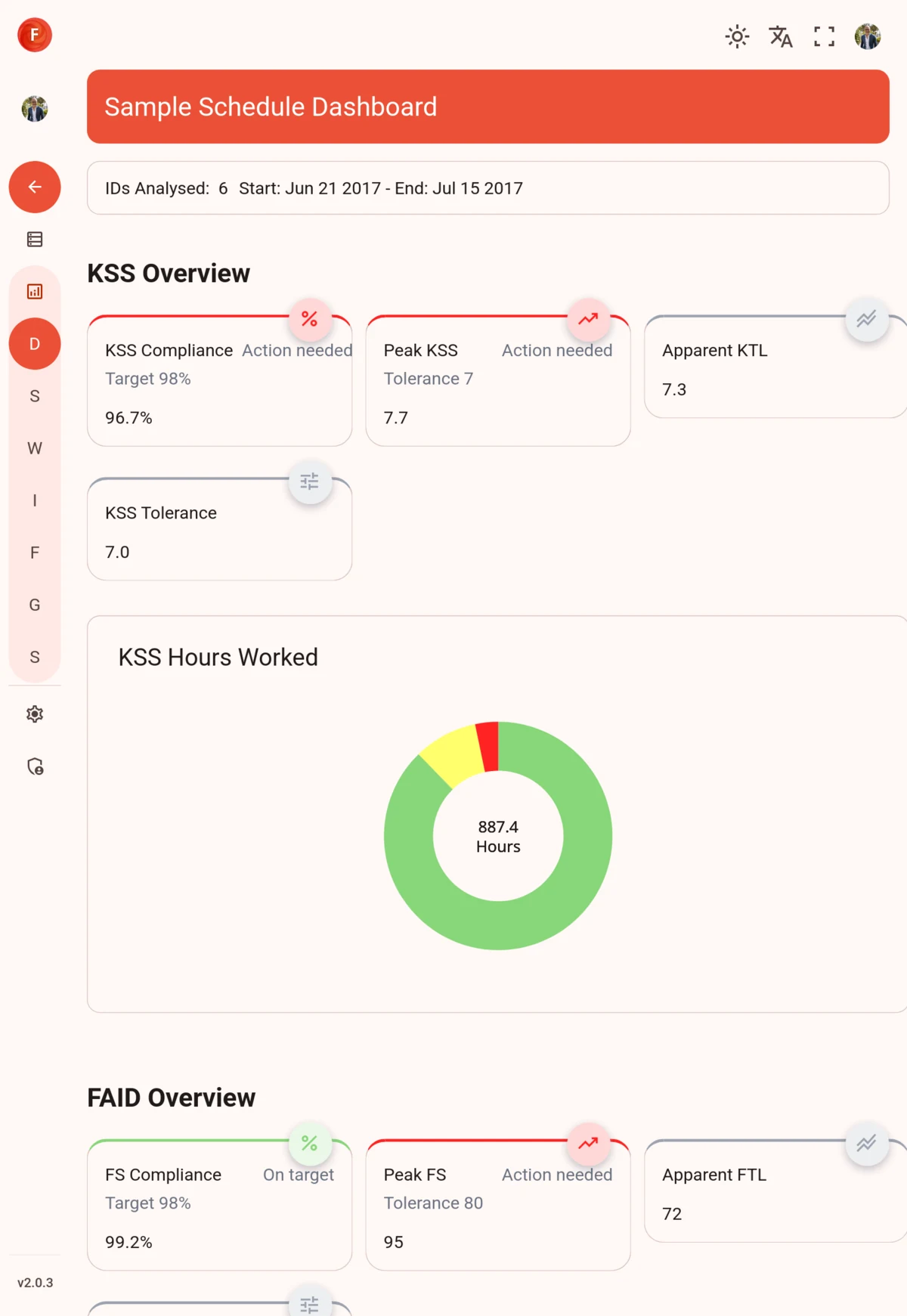
FAID Quantum brings schedule preparation, FAID and KSS indicators, comparative views and reporting into one browser-based workflow. For integrated workflows, the developer API and native library let the consuming system choose managed or local calculation while applying the same FAID methodology.